
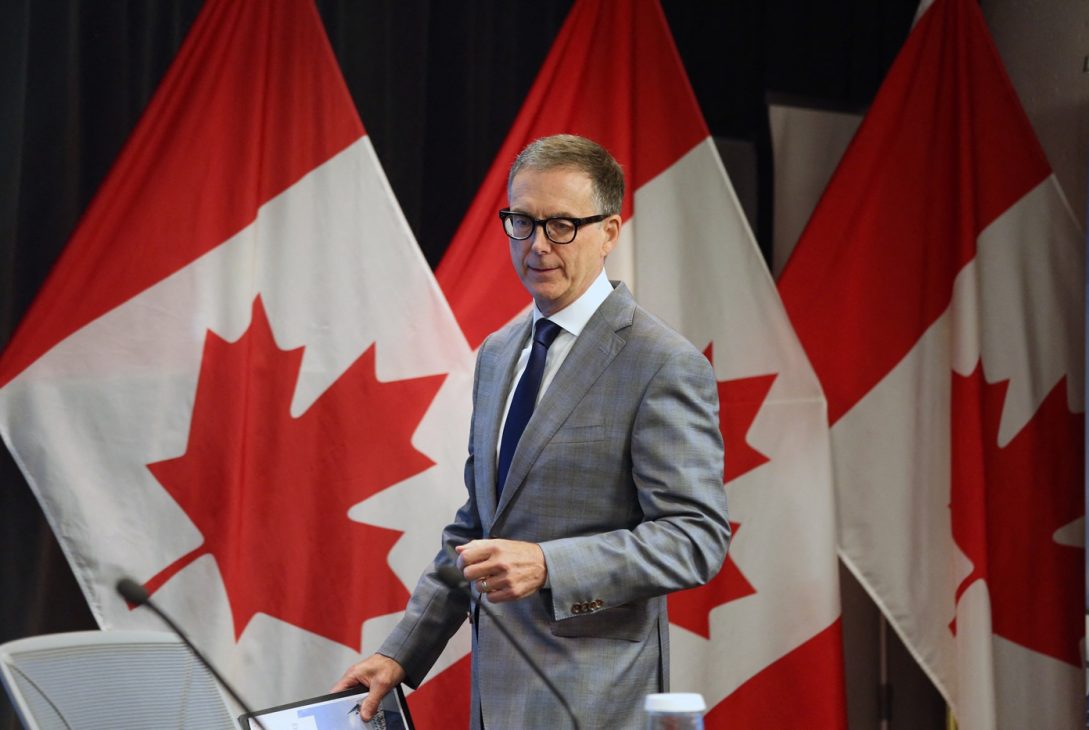
The Bank of Canada held its benchmark interest rate at 2.75% today, citing a Canadian economy that’s “softer but not sharply weaker” and inflation data that remains mixed.
But beyond the decision to keep rates steady, the more notable shift was in tone: the Bank is pulling back from forecasting and leaning more heavily on incoming data to guide its next move.
“With uncertainty about U.S. tariffs still high… Governing Council decided to hold the policy rate as we gain more information,” the Bank said in its statement, pointing to both upside risks to inflation and signs of economic softness.
While the decision itself was widely expected, economists are focusing on what the Bank didn’t say. It dropped earlier language about the limits of monetary policy in a trade war, and instead emphasized a more reactive stance—one that waits for hard data rather than steering expectations.
“There was more diversity of views” about the path ahead, Governor Tiff Macklem said in his opening statement. “On balance, members thought there could be a need for a reduction in the policy rate if the economy weakens… and cost pressures on inflation are contained.”
Data over direction
That more cautious, wait-and-see tone was flagged by several economists following the decision.
“The Bank’s rate decision and commentary were right down the middle of the plate,” said BMO’s Douglas Porter. “While the forward-looking statement suggests that Governing Council is not eager to cut much further, we suspect that a combination of softer activity and milder core inflation trends will prompt additional action.”
Porter also noted the Bank’s explicit admission that it is “being less forward-looking than usual,” a rare and deliberate shift that reflects how difficult it has become to model the effects of rising tariffs and global trade tension.
RBC economist Claire Fan added that Q1’s stronger-than-expected GDP growth was likely inflated by “tariff front-running”—the rush to ship goods ahead of anticipated tariff hikes—which means Q2 is likely to show weaker activity. “We think the path of the BoC will be largely determined by the extent of further softening in the economy,” Fan wrote.
CIBC’s Andrew Grantham said the Bank is “keeping its powder dry,” while still maintaining a bias toward easing. He expects a 25-basis-point rate cut in July, assuming inflation data calms and labour market weakness builds.
“While we can’t argue against the acceleration seen in core measures of inflation recently,” he noted, “we do think this has partly been due to retaliatory tariffs, particularly in areas such as food where pass-through happens quite quickly.”
Watching inflation and employment
Despite headline CPI easing to 1.7% in April, the Bank noted that core inflation ticked up, with businesses reporting they plan to pass on tariff-related cost increases. Stripping out the federal carbon tax cut, inflation came in at 2.3%—slightly higher than the Bank had expected.
Meanwhile, labour market conditions have softened, with job losses concentrated in trade-exposed sectors like manufacturing and wholesale. The unemployment rate has climbed to 6.9%, and further signs of weakness in this Friday’s jobs report could increase pressure on the Bank to act next month.
“Consumers and businesses are incredibly cautious in their outlook, yet spending and activity have mostly held up,” said Porter. “That tension is what’s making it so hard to chart a path.”
What’s next?
Markets are still betting on at least one more cut by the end of summer. Economists generally agree that the July 30 decision will hinge on two things: whether inflation pressures show signs of cooling, and whether labour market slack continues to build.
“We expect there will be enough evidence of slack building up in the economy,” Grantham wrote, “and that core inflation is being impacted by retaliatory tariffs, for policymakers to feel comfortable cutting rates by 25bp in July.”
Bank of Canada Bank of Canada Governor Tiff Macklem bank of canada rate decision BoC BoC rate decision Dashboard Editor's pick tiff macklem
Last modified: June 5, 2025


