

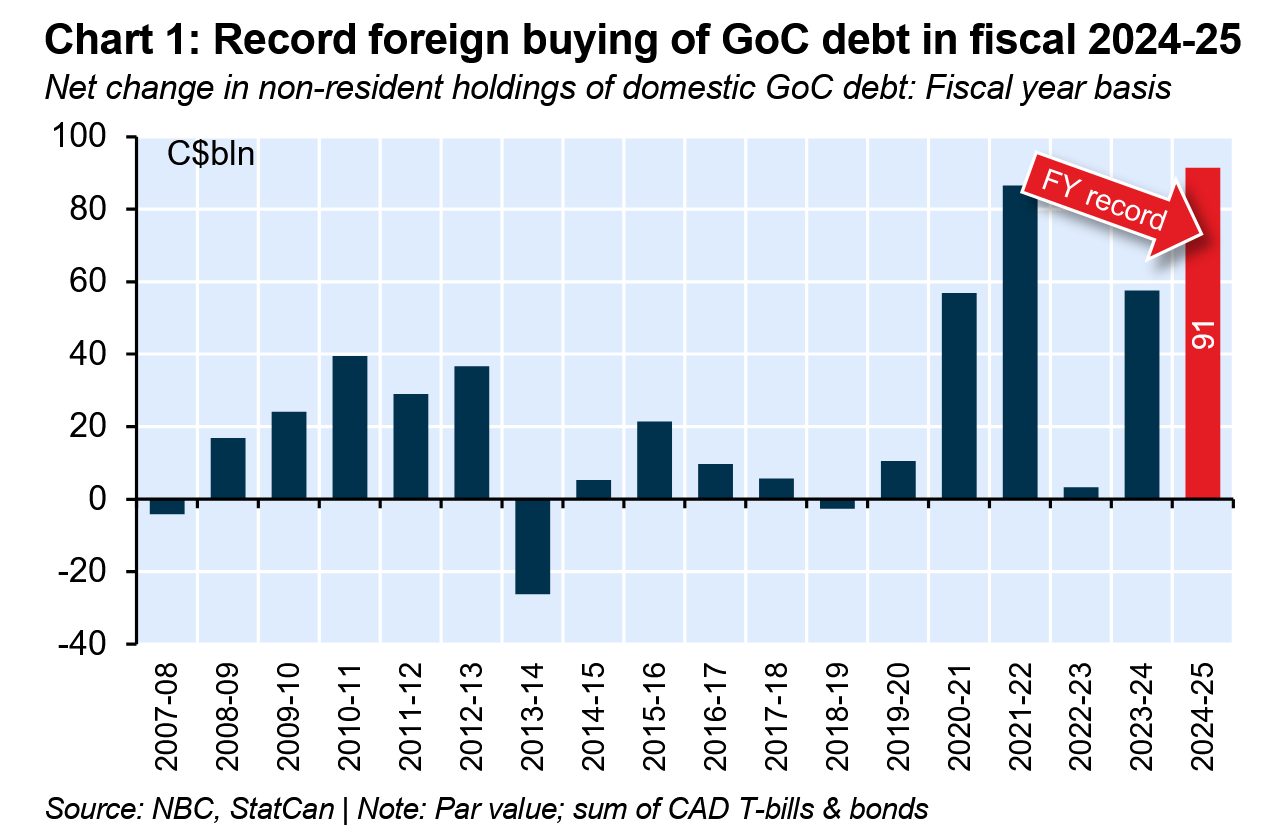
According to a new report from National Bank’s Warren Lovely, foreign investors absorbed about 60% of all newly issued federal debt during the 2024–25 fiscal year.
That’s a record amount—$91 billion worth of Canadian T-bills and bonds purchased by non-residents over 12 months—and enough to raise serious questions about who’s really propping up Ottawa’s borrowing needs.
“Non-residents don’t get to vote in Canadian elections; nor do they occupy seats in Parliament. But foreign investors have ample opportunity to express their view on the government’s chosen direction,” Lovely points out. “If displeased, they could stop buying and/or demand relatively fatter yields and/or steeper curves to stay involved.”
A growing reliance on offshore buyers
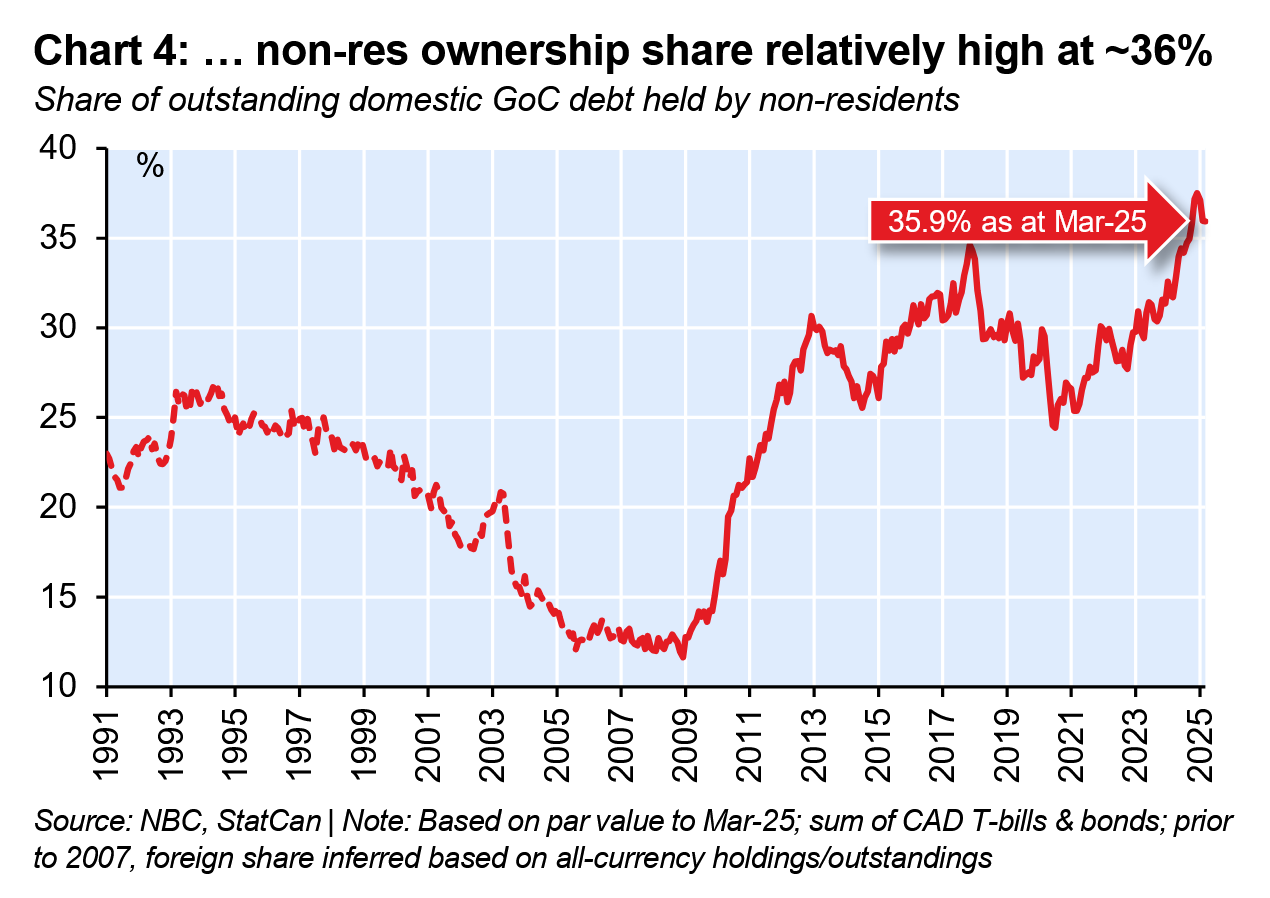
The share of federal debt held by non-residents has climbed sharply in recent years. As of March, foreign investors owned $512 billion in Government of Canada debt, about 36% of the total outstanding. That’s well above the historical average of 23%, and just shy of the all-time high reached in late 2024.
This rise in foreign participation has been a net positive in many respects, having added liquidity to the domestic bond market and helped Ottawa finance its growing deficits without overwhelming domestic investors, Lovely notes. Buyers span a wide spectrum—from central banks and sovereign wealth funds to insurance companies, pension funds and fast-money hedge funds.
But as the Bank of Canada noted in its latest Financial Stability Report, there are also risks. Many of these investors are using leverage, and some could retreat quickly if conditions change or their risk tolerance shifts.
A sudden pause, then signs of life
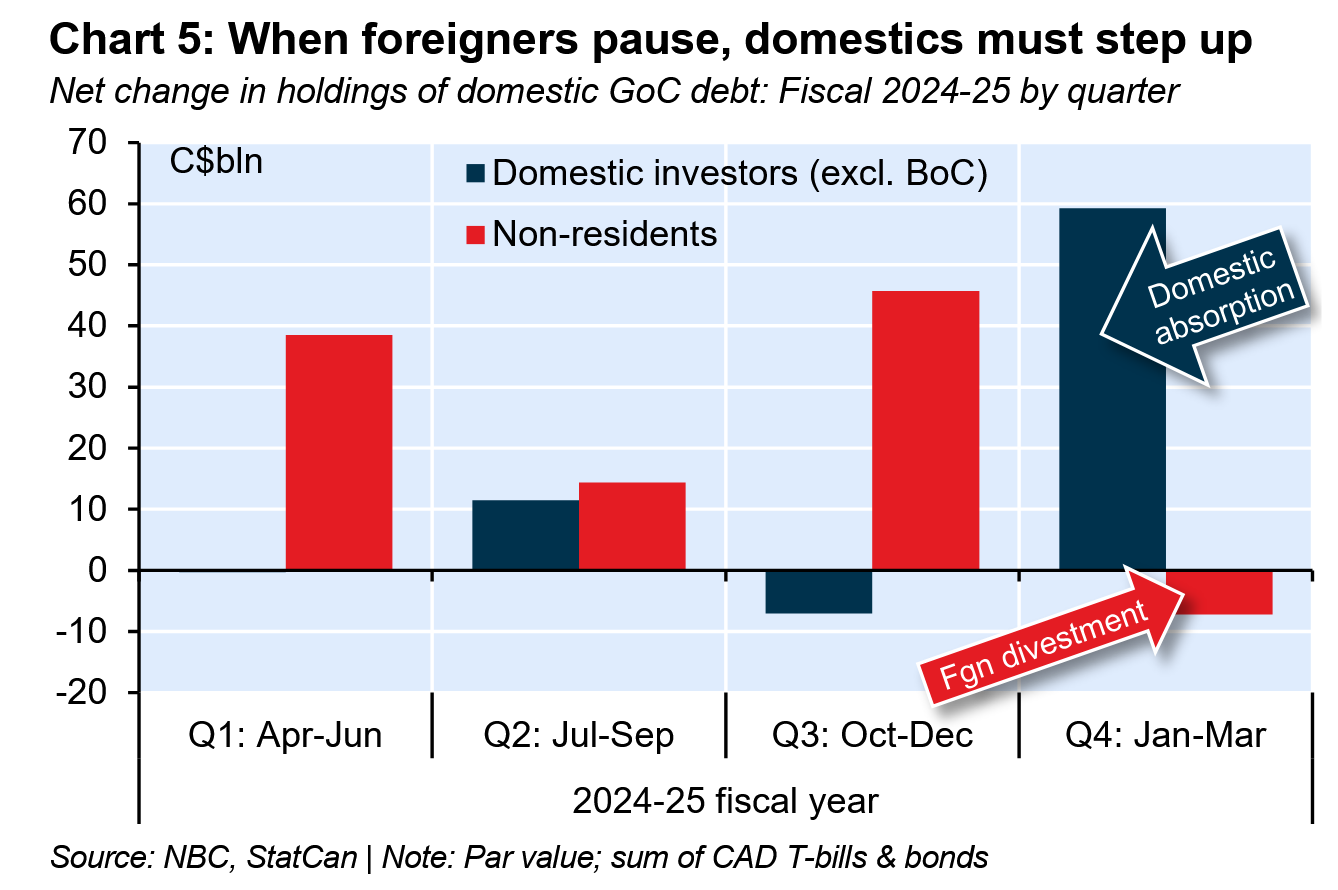
Interestingly, despite the record pace of foreign buying over the full fiscal year, the final quarter told a different story.
From January to March 2025, non-residents didn’t add a single dollar of net new federal debt to their portfolios. That left domestic investors to soak up all of Ottawa’s new issuance—the most they’ve taken on in a single quarter since the pandemic-era borrowing spree of mid-2020.
The timing wasn’t ideal, as those months saw a flurry of U.S. tariff threats, a volatile Canadian dollar, and political uncertainty ahead of the April federal election. “It may be that certain non-residents simply backed away early in the calendar year in hopes the picture would clear,” Lovely wrote.
There’s already some evidence that the pullback may be temporary, however. National Bank points to fresh data showing non-residents were responsible for about 30% of Government of Canada bond and T-bill trading volumes in April—outpacing even domestic banks and institutional clients. They’ve also been successful bidders in recent bond auctions, taking down roughly one-quarter of new supply since the new fiscal year began.
Why this matters for borrowers and markets
At a time when Ottawa is expected to increase its borrowing—without a budget yet in place, but with campaign promises pointing to bigger deficits—the federal government will continue to depend heavily on demand for its bonds.
If foreign appetite fades or becomes more selective, it could force bond yields higher to attract enough buyers. That, in turn, would increase the government’s borrowing costs—and could influence everything from fixed mortgage rates to broader financial conditions.
As Lovely puts it, “Ottawa must guard against budgetary complacency.” Canada may still look solid compared to some of its peers (the U.S., for example, just saw a downgrade), but global investors have choices—and expectations.
Whether or not they’re in the room, foreign investors may end up holding more sway over Ottawa’s fiscal future than the opposition bench.
Bank of Canada bond yields Editor's pick foreign investment investors national bank of canada Warren Lovely
Last modified: May 28, 2025


